Target Merge: rules, physics, and chain reactions
How a small arithmetic ruleset becomes a spatial puzzle when number combinations meet contact, gravity, and a limited container.
Target Merge combines two kinds of reasoning: arithmetic and space. A pair of numbers may make a valid sum, but they still need to meet inside a jar of rolling and stacked balls. A useful drop considers both the value on the next ball and the physical arrangement below it.
I built the mobile game with React Native, Expo, and Skia. The core is an endless run: make merges, build chains, and keep the pile below the danger line.
A compact set of rules
The first rule is a pair merge: two touching balls combine when their sum is a positive multiple of ten. That includes 3 + 7 = 10, but also 12 + 8 = 20 and 10 + 20 = 30. A merged ball remains in play, so the rule continues to matter beyond the original 1–9 values.
The second rule is a matching triple: three connected balls with the same value from 1 to 9 combine into their sum. Three fours make twelve. That twelve can later meet an eight and produce twenty.
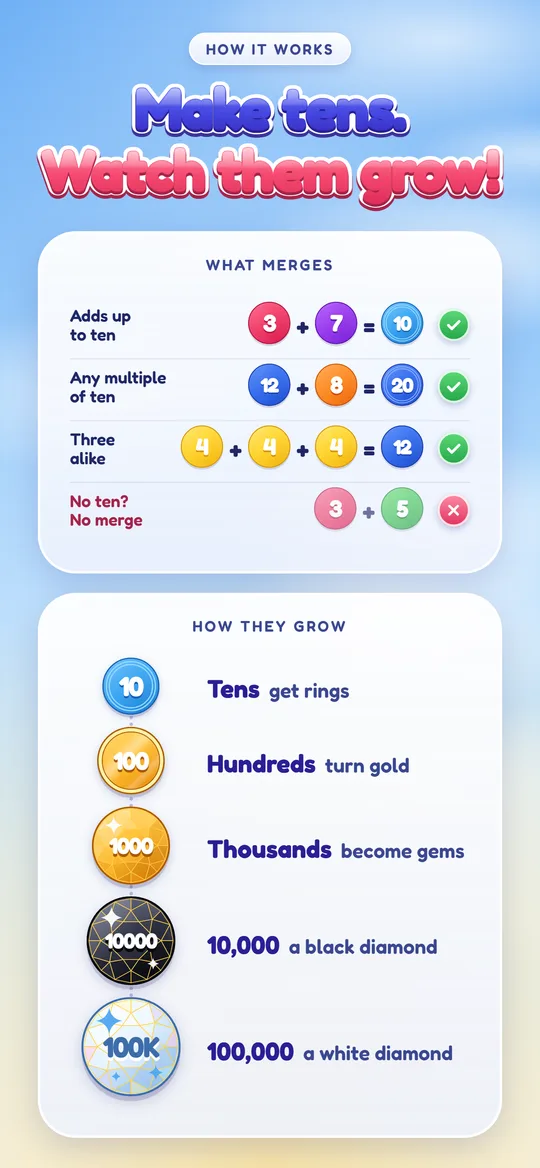
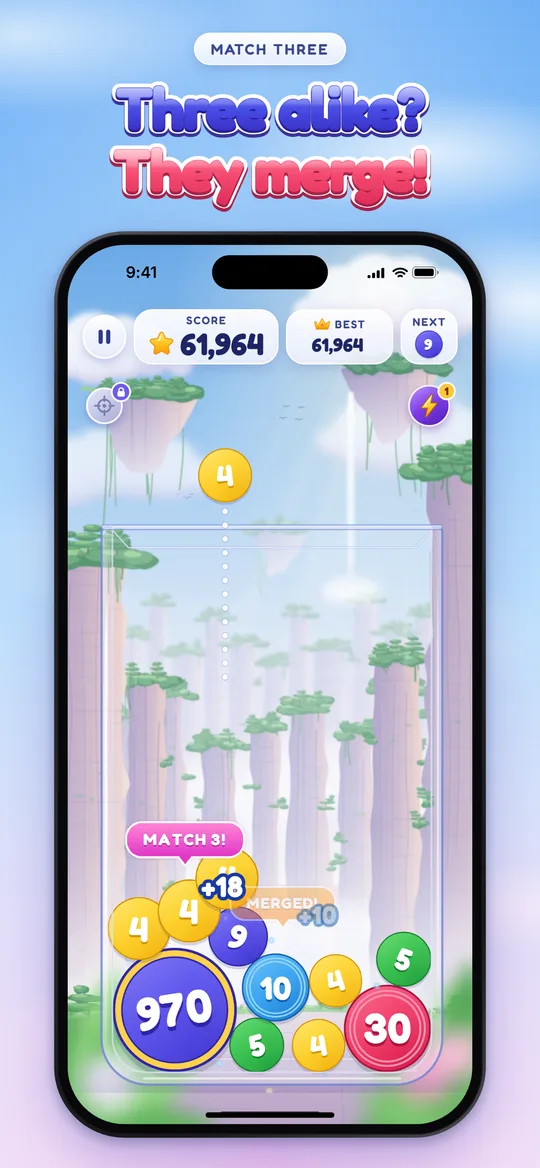
These rules overlap without being identical. A player can look for an immediate pair, set up a triple, or create a value that will be useful for a later combination. The result of a merge is another piece of the puzzle.
Contact makes arithmetic spatial
A grid puzzle gives every piece a fixed position. Target Merge uses dropping, rolling, and stacking. A mathematically useful ball may settle somewhere inconvenient, or a new drop may rearrange the pile enough to bring an existing pair into contact.
That relationship gives placement a purpose beyond selecting a number. The container is a limited resource, and the player is managing access to useful combinations as well as the height of the pile.
A chain needs readable feedback
When a merged ball can merge again, one drop can create several events. Chain reactions multiply the score, so the interface needs to communicate both the resulting numbers and the fact that the score is growing through a sequence.
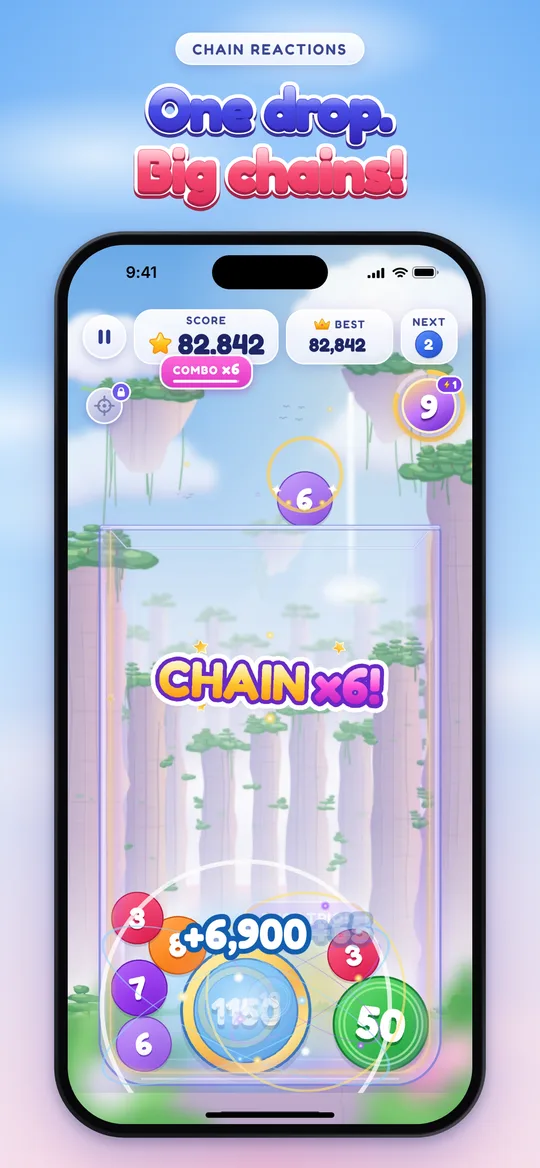
The danger line gives that activity a boundary. The run ends when a settled ball stays above the line for 1.5 seconds. A short delay prevents a momentary movement from being treated in the same way as a pile that has actually run out of space.
Extra rules stay explicit
Power-ups add controlled exceptions. Combo Rush temporarily allows three connected small balls to merge when their sum is a positive multiple of ten. Focused Merge combines the balls inside a targeting circle into one ball with their total value.
Those behaviors are different from the base rules, so they need an explicit activation and an understandable scope. Their value comes from changing the player's options at a particular moment.
Keeping play local
Scores, records, game history, and settings are stored locally. A run does not require sign-in, and gameplay works offline. Advertising and purchase verification use online services separately from that core loop.
The game has optional sound, music, haptic feedback, and reduced motion settings. A busy chain reaction is enjoyable only if the feedback remains comfortable and understandable for the person playing.
What I want this project to show
A small ruleset can create varied decisions when its rules interact with physical space. Target Merge explores that relationship through contact, arithmetic, limited capacity, and repeatable feedback rather than a large set of unrelated mechanics.
The Target Merge project page contains the feature overview and download link. The studio page provides the same product visuals and current release information.